The 2026 Guide to Grow Lights for Apartments with No Sun

So, you live in a “cave.” Maybe your windows face a brick wall, or you want to put a Monstera in a windowless hallway. You’ve bought the plants from our [Master List of 15 Low Light Survivors], but even “low light” doesn’t mean “no light.”
In the past, adding artificial light meant hanging ugly, industrial purple lamps that made your living room look like a sci-fi laboratory (or a questionable basement operation).
Welcome to 2026. The technology has changed.
Modern grow lights are sleek, warm-white, and designed to blend seamlessly into high-end interior decor. This guide will teach you how to supplement the sun without ruining your apartment’s aesthetic.
💡 Trend Alert: The Death of “Blurple” (Blue + Purple)
If you take one thing from this guide: Do not buy purple lights.
Old-school LEDs mixed Red and Blue diodes (creating purple) because it was energy efficient. However, plant science in 2026 has confirmed that “Full Spectrum” white light is not only better for photosynthesis, but it allows you to see the true color of your plants (and spot pests).
What to look for on the box:
- Kelvin (K): You want 3000K to 4000K. This is a “Warm White” or “Neutral White” that matches your regular living room lamps.
- CRI (Color Rendering Index): Look for 90+. It means colors look natural.
🛠️ The 3 Best Grow Light Solutions for Apartments
You don’t need a greenhouse setup. You need one of these three discreet options.
1. The “Secret Agent” (The Bulb Swap)
Best for: Floor plants and desk lamps.
This is the easiest hack. You simply buy a High-Output Full Spectrum LED Bulb (standard E26 base) and screw it into your existing IKEA lamp or architect desk lamp.
- Why it works: No one knows it’s a grow light. It just looks like a reading lamp.
- The Spec: Look for bulbs that draw at least 10 to 15 ‘Actual Watts’ (ignore the “equivalent” numbers).
- Placement: Aim it directly at the top of your Snake Plant or Ficus.
2. The “Halo” Ring Light
Best for: Small pots on tables and shelves.
Dominating the market in 2026, these are small LED rings mounted on a telescopic stick that you stab directly into the soil.
- Aesthetic: They create a literal “halo” over your Pothos or ZZ Plant.
- Function: Because they are so close to the leaves, they don’t need to be super powerful. Perfect for giving a boost to a specific plant in a dark corner.
3. The Under-Cabinet Strip
Best for: Bookshelves and Kitchen Counters.
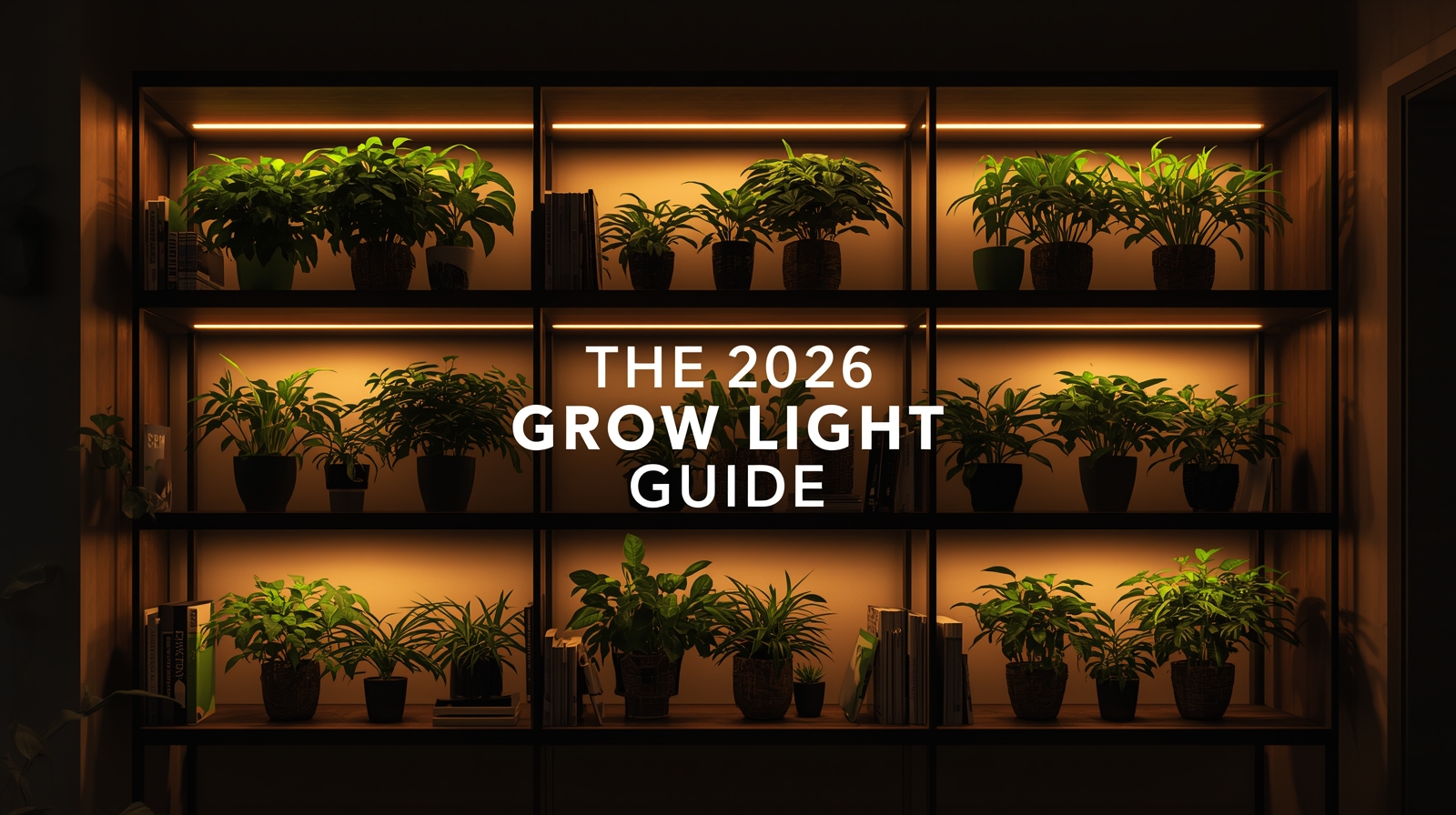
If you have a “Plant Shelfie” with trailing vines (like the ones in our [Pet-Safe Plants Guide]), this is the solution.
- Installation: Peel and stick LED strips under the shelf above the plants.
- The Effect: It backlights your shelf, turning a dark storage unit into a glowing green display case.
📏 The Golden Rule: Distance is Everything
Buying the light is easy. Placing it is where everyone fails.
Light follows the Inverse Square Law. Roughly speaking: If you double the distance between the light and the plant, the plant receives only 25% of the energy.
- Too Far: A grow light on the ceiling 5 feet away from a floor plant does almost nothing. It is useless.
- Too Close: Touching the leaves will burn them.
- ** The Sweet Spot:**
- Low Light Plants: 12 to 24 inches away.
- High Light Plants: 6 to 12 inches away.
⏰ How Long Should I Leave Them On?
Plants are not like us; they don’t sleep in 8-hour cycles, but they do need darkness to respire.
- The Schedule: Aim for 12 to 14 hours ON per day.
- The Automation: Do not rely on your memory. Buy a cheap Smart Plug (WiFi) or a mechanical timer. Set it to turn on at 7:00 AM and off at 9:00 PM. Consistency is key to tricking the plant into thinking it’s outdoors.
📉 Electricity Bills: Will It Cost a Fortune?
This is the most common fear for renters. Let’s do the math for 2026 energy prices.
Most LED grow bulbs for apartments consume about 10 Watts.
If you run it for 12 hours a day:
- 10W x 12h = 120 Watt-hours per day.
- That is roughly 3.6 kWh per month.
- at an average cost of $0.15 per kWh, running that light costs you $0.54 per month.
Verdict: It costs less than a cup of coffee to run a jungle of 5 lights for a whole month.
Read Next:
Related Articles

About the Author

0 Comments